Here's something most homeowners don't know about 13.25x13.25x4 filters: the size isn't a typo. It's an actual-size cut. The filter really measures 13.25 by 13.25 by 4 inches, because the slot inside your side-return air handler measures exactly that much. Swap in a 14x14x4 you grabbed from a hardware store? You've just opened almost a half-inch gap around the frame. Every minute the blower runs, that gap lets unfiltered air slip straight onto the coil.
We've been manufacturing filters in the USA since 2013, and we've helped millions of family protectors keep their indoor air clean. The 13.25x13.25x4 has quietly become one of our most-asked-about cuts, especially in South Florida homes where the AC barely gets a day off. If your system is cycling longer than it used to, or you're spotting clogged filter signs like unusual dust buildup or weak airflow at the vents, a wrong-size or backwards filter is almost always the reason. This guide walks you through the right install, step by step, in under ten minutes. No tools needed.
TL;DR Quick Answers
Thermostat off. Open the slot. Pull the old filter. Drop the new one in with the arrow facing the blower. Close up. Turn the system back on.
Never swap in a 14x14x4. It leaves a gap and leaks air around the frame.
The arrow faces inward toward the coil, not outward toward you.
Change it every six months in Florida. Stretch to 9 or 12 months in cleaner, pet-free homes.
Write the install date on the cardboard frame with a marker.
Top Takeaways
13.25x13.25x4 is a real cut size, not a rounding of 14x14x4. The two do not interchange.
Kill power at the thermostat before you open the filter slot.
The arrow on the filter faces the coil and the blower. If you can read it from the room, it's backwards.
A correctly seated filter is one of the fastest energy savings tips you can act on this weekend. It costs nothing extra.
Different slot, bigger size, same rules. If you've got a 16x25x4 elsewhere in the house, our guide on larger filter maintenance covers that one.
The Install, Start to Finish
What a Side-Return System Actually Is
A side-return air handler pulls return air in through the side of the cabinet, not the bottom. In South Florida, you'll typically find these in closet or attic setups, and most of them use a 4-inch-deep pleated media air filter instead of the thin 1-inch kind. New to home air filtration? Here's the quick orientation. Filter slots get cut to fit the housing, not to match the nominal sizes sold at retail. That's how you end up with a cut like 13.25x13.25x4 instead of a rounded 14x14x4. Force the wrong size in, and you've opened a gap around every edge of the frame. Your blower pulls air through that gap, not through the pleats. Your filter becomes decoration.
What You Need Before You Start
You need very little to do this job right. Grab one new 13.25x13.25x4 pleated media filter and match the MERV rating to your system. If that part feels uncertain, this AC filter guide sorts it out in a couple minutes.
A flashlight or phone light
A marker for dating the new filter
A trash bag for the old one
Optional: a microfiber cloth to wipe dust out of the slot
That's it. No tools, no screws in most setups, no half-hour tutorial.
The 5-Step Install
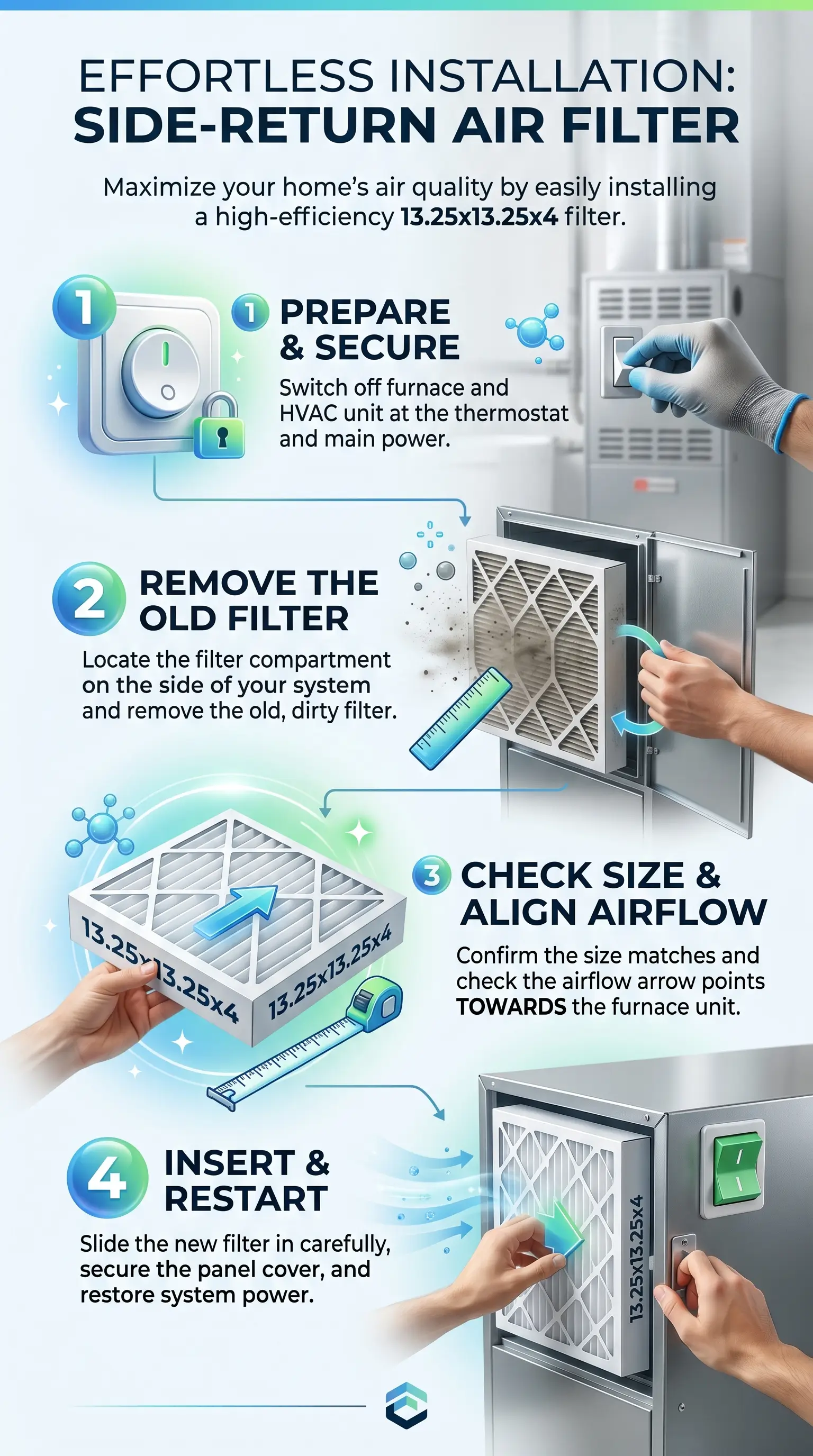
Turn the thermostat to Off. Don't skip this step. If the blower kicks on mid-install, it'll pull dust onto the coil. Worst case, it'll suck the new filter in at a crooked angle.
Open the side-return filter slot. Look for the door on the side of the air handler cabinet. Some swing on a hinge. Some slide straight out. You'll find a latch, a thumbscrew, or both holding it shut.
Slide out the old filter and check the airflow arrow. Pull the old filter straight out. Before it hits the trash bag, look at the airflow arrow on the cardboard frame. That direction is the direction your new one goes.
Install the new filter with the arrow pointing toward the blower. The arrow on the frame points inward, toward the coil and fan. Never outward toward the room. Install it backwards, and the pleats collapse under blower pressure. Airflow to your vents drops fast.
Date the frame, close the slot, and turn the system back on. Take your marker and write today's date on the cardboard edge. Latch or screw the access door shut. Switch the thermostat back on. Stand under a supply register for a few seconds and listen for steady, even airflow.
Mistakes That Cost Homeowners the Most
Swapping in the wrong dimension because "it was all the store had." Understanding common filter sizes and the nominal-versus-actual distinction saves you from this one every time.
Installing the arrow backwards. This is the single most common field mistake we see, period.
Leaving the system on while the slot is open. Dust rides the airflow straight onto the evaporator coil.
Waiting until airflow feels weak. By the time you notice, the coil has already loaded up and the system's been working overtime for weeks.
MERV Ratings in Plain English
MERV is short for Minimum Efficiency Reporting Value. It's the number that tells you how fine the filter's mesh actually is. MERV 8 handles everyday household dust and lint. MERV 11 is our go-to recommendation for pet owners and families managing allergies. MERV 13 steps up for wildfire smoke or homes with immuno-sensitive family members. Want the full picture of what MERV actually measures? This breakdown of MERV 8 explained is a solid primer.
Pro tip: higher MERV isn't automatically better. Older blowers struggle to pull air through denser filter media. Check your system's rated MERV ceiling before you upgrade past 11.
If You're Thinking Beyond the Filter
Filters do the heavy lifting for indoor air quality. They're not the only tool in the box. Homes dealing with persistent odors or biological contaminants sometimes add UV light installation inside the air handler. The UV neutralizes mold and bacteria growing on the coil surface. It doesn't replace a correctly installed 4-inch filter. It stacks on top of one.
Alternatives: Washable and Reusable Options
Most 13.25x13.25x4 side-return systems run disposable pleated media for a reason. The 4-inch depth gives you serious surface area, and the pleats trap particles with minimal airflow loss. If you're working a different-size slot elsewhere in the house and curious about other categories, a washable filter guide explains how rinseable 2-inch filters stack up, and this look at reusable filter options covers the real-world trade-offs in airflow and filtration. Both categories work for specific setups. Neither one drops into a 13.25x13.25x4 cut without compromise.

"Nine times out of ten, folks calling us about weak airflow or a frozen coil don't have a broken system. They have a filter that's either the wrong size or pointing the wrong way. A MERV rating only matters if the filter actually seals to the frame."
7 Essential Resources for Homeowners
Seven sources we trust on indoor air quality.
EPA — Improving Your Indoor Environment. The federal agency's homeowner-facing guide to indoor air quality, ventilation, and filtration basics.
U.S. Department of Energy — Air Conditioner Maintenance. A short, practical checklist covering filters, coils, and airflow for residential AC systems.
ENERGY STAR — Heat & Cool Efficiently. Monthly filter-check guidance plus sealing and insulation tips that pair with any filter upgrade.
NIH / NIEHS — Indoor Air Quality. The health-research perspective on what indoor air exposure actually does to the body over time.
American Lung Association — Indoor Air Quality. A non-profit health resource on pollutants, asthma triggers, and filtration decisions for sensitive households.
ASHRAE. The professional standards body for HVAC engineers. Where MERV ratings (ASHRAE 52.2) and ventilation standards originate.
CDC — About Indoor Air Quality. Public health guidance on what to watch for and when poor indoor air warrants action.
3 Statistics Worth Knowing
1. Americans spend about 90% of their time indoors, where pollutant levels run 2 to 5 times higher than what you'd breathe outside. Your return-duct filter is the last line between that air and your family's lungs. (Source: EPA)
2. Swapping a clogged filter for a clean one can drop your AC's energy consumption by 5% to 15%. On a South Florida cooling bill, that pays the filter back in the first month. (Source: U.S. Department of Energy)
3. Heating and cooling eats nearly half of the energy used in an average U.S. home. A correctly seated, correctly sized filter is the cheapest lever you've got on that number. (Source: ENERGY STAR)
Final Thoughts
Installing 13.25x13.25x4 air filters in a side-return is one of the easiest maintenance jobs you'll do this year. It takes less time than unloading the dishwasher. Two things make it feel harder than it is: finding the actual 13.25x13.25x4 size, because most retailers only stock nominal sizes, and remembering which direction the arrow points. Handle both, and you've solved 95% of side-return filter problems. The rest is a calendar reminder.
What we see after years of manufacturing filters and talking with family protectors: the people who stay ahead of this are the ones who buy ahead. They order bulk pack filters so a fresh one is always waiting on the shelf. They date the frame. They swap at six months without overthinking it. The calls we field about frozen coils and weak airflow almost always come from households that waited for something to feel wrong.
Frequently Asked Questions
Is 13.25x13.25x4 the same as 14x14x4?
No. 13.25x13.25x4 is the actual cut dimension, meaning what the filter really measures on a tape. 14x14x4 is a nominal retail size, and it usually measures closer to 13.75x13.75x3.75. Substituting one for the other opens gaps in the frame, and unfiltered air slips straight past.
Which way does the airflow arrow point on a side-return?
Toward the blower and coil. Never toward the room. The arrow tracks the direction the air moves as it enters the air handler.
How often should a 13.25x13.25x4 filter be replaced?
Every six months in a typical Florida home with year-round AC runtime. Cleaner environments with no pets can stretch that to 9 or 12 months. The first time through, check at the 3-month mark so you calibrate to your actual household.
Where do I find a 13.25x13.25x4 filter if it's not at my hardware store?
Non-nominal sizes rarely sit on big-box store shelves. You've got two paths: order direct from a manufacturer that cuts this size, or check online. For the exact 13.25x13.25x4 cut, going direct to the manufacturer is the most reliable route.
What MERV rating should I pick?
MERV 8 handles everyday household dust. MERV 11 is what we recommend to pet owners and families managing allergies. MERV 13 is best for wildfire smoke and homes with immuno-sensitive family members. Before you upgrade to 13, double-check that your blower can handle the denser media. Higher MERV restricts airflow in older systems.
Ready for a Fresh Filter?
The smoothest installs start with the right filter already on the shelf. You can shop premium 13.25x13.25x4 air filters at Filterbuy. We manufacture them in the USA in MERV 8, 11, and 13 options, shipped direct from our factory to your door. Order two at a time, and your side-return is handled for the full year.
Learn more about HVAC Care from one of our HVAC solutions branches…
Filterbuy HVAC Solutions - Miami FL - Air Conditioning Service
1300 S Miami Ave Apt 4806 Miami FL 33130
(305) 306-5027
https://maps.app.goo.gl/Ci1vrL596LhvXKU79